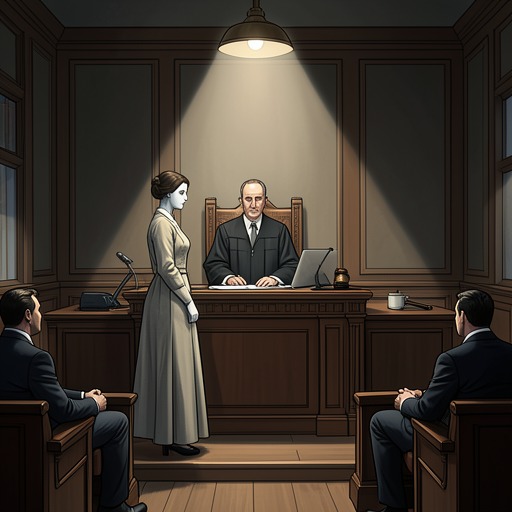
Los Angeles Court
𝐋𝐚𝐜𝐮𝐧𝐚 | 𝑱𝒆𝒐𝒏 𝑱𝒖𝒏𝒈𝒌𝒐𝒐𝒌The Los Angeles courthouse is the decisive public setting for the legal reckoning with Robert Jefferson’s sexual crimes. Within its walls, Shelby Anderson Barnum’s private trauma is converted into testimony, challenged by the defense, heard by a judge and jury, and answered by a prison sentence. The building therefore marks more than a location: it is the threshold where years of fear become an official record and where Shelby’s insistence on being believed produces a concrete institutional consequence.
A Public Space for Private Harm
The courthouse gathers together the competing languages of the case. Before Shelby enters, police manage journalists, activists, and protesters outside, while threats against victims make the crowd feel oppressive and unsafe. The public attention surrounding the trial does not erase the danger; instead, it exposes how easily survivors can be surrounded by scrutiny even when they are seeking protection. Shelby responds by taking Jungkook Jeon’s hand and interlacing their fingers, turning his presence into a visible source of reassurance rather than allowing the courthouse to become an isolating institutional space.
The building also connects Shelby with other survivors. On the day of the verdict, she sees Dakota, Sandy Sanchez, and other women who had been trapped by Robert Jefferson’s actions. Their presence broadens the case beyond one accusation or one family. The courthouse becomes a shared site of recognition in which several women confront the same perpetrator and wait together for the system to name what happened to them.
Complaint, Testimony, and Credibility
The legal process begins with a complaint against Robert Jefferson. The reporting character explains to an agent that complaints have already been made against him but were never taken seriously, identifying institutional neglect as part of the harm that brought the case to court. The courthouse consequently represents both a possible correction of earlier disbelief and a reminder that justice has been delayed by failures in the systems meant to receive victims’ accounts.
At the hearing, Shelby is called to testify. She swears on the Bible to tell the truth, then faces questions from the defense attorney designed to destabilize her. She maintains outward composure until she recounts what happened with her abuser, when tears rise and run down her face. The courtroom scene makes testimony physically demanding: truth is not presented as effortless speech but as an act performed under pressure, in front of the accused, the judge, the jury, and the people who have come to support her.
The defense attempts to recast her testimony as a financial scheme by asking whether the trial is intended to extract money from Robert Jefferson. Shelby rejects that framing directly. She acknowledges that malicious people can falsely pursue money, but argues that such cases are precisely what allow attorneys and institutions to make genuine victims of rape and sexual assault feel guilty, unheard, and unbelievable. Her answer shifts the courtroom’s focus from the supposed motives of a survivor to the broader social consequences of treating every accusation as suspect.
The Verdict and Its Consequences
The courthouse reaches its central moment when the judge asks the jury for its verdict in case number 1465. Robert Jefferson is found guilty of three sexual assaults, two attempted rapes, two rapes of minors, and four rapes of adults. The sentence is twenty-five years in prison and a ninety-thousand-dollar fine. At the victims’ request, one symbolic dollar is to be paid to each of them, a decision that rejects his wealth as the measure of their loss and makes acknowledgment, rather than personal enrichment, the stated purpose of compensation.
Shelby remains in the courtroom after it has emptied, absorbing the fact that her abuser will be behind bars for twenty-five years. The symbolic dollar matters to her because she proposed it herself; she does not want Robert Jefferson’s fortune. In the courthouse, that gesture becomes a final refusal of the defense’s insinuation that money motivated her. The judgment cannot return the years taken from the victims, but it confirms their account in the language of criminal law and removes Robert Jefferson from their immediate future.
The verdict produces a visible change in the people inside the building. Shelby closes her eyes in relief, cries, and embraces Jungkook. Dorcas Peters, Cassiopée Smith, and Namjoon Kim join them. Connor Barnum approaches with Lydia Barnum and embraces his daughter while crying, while Lydia watches with a smile. The courthouse thus becomes a place where legal recognition releases accumulated private tension into collective grief, relief, and familial support.
Violence at the Edge of Justice
The courthouse does not offer uncomplicated safety. After the trial, when Shelby remains behind, Catherine Jefferson approaches with anger and strikes her across the face, calling her an insult and demanding to know how she dared challenge her husband. Shelby answers that Robert Jefferson has damaged lives and that Catherine allowed him to continue. The assault shows that a legal victory does not immediately dissolve the loyalties, hostility, or intimidation surrounding an accused man.
The confrontation also places the courthouse between institutional closure and continuing interpersonal conflict. Robert Jefferson has been convicted, but Catherine’s slap attempts to reopen the case as a personal attack on Shelby. Madison Jefferson’s later apology and reconciliation with Shelby, followed by Jungkook’s concern over the red mark on Shelby’s face, redirect the scene toward accountability and repair. Even after judgment has been delivered, the building remains a site where responsibility is negotiated among survivors, relatives, former friends, and those who protected or defended the perpetrator.
Narrative Significance
As a setting, the Los Angeles courthouse concentrates the story’s movement from silence to speech and from speech to consequence. Earlier private acts of apology or protection cannot substitute for public accountability: Jungkook Jeon’s attempt to apologize, his declaration that he wants to help Shelby overcome her fears, and his defense of her before Connor Barnum belong to the intimate sphere. At the courthouse, by contrast, Shelby’s words must withstand formal questioning, and the judgment must be pronounced by an institution rather than by a lover or a parent.
The courthouse therefore carries a productive tension. It is surrounded by reporters, activists, threats, and hostile attention, yet it also houses the hearing at which Shelby refuses to be reduced to a financial motive and the verdict that recognizes the scale of Robert Jefferson’s crimes. Its narrative function is to transform testimony into an official truth while preserving the emotional and bodily cost of that transformation. The building closes the legal chapter of Shelby’s ordeal without pretending that conviction erases trauma; its most important change is that fear is no longer left without a public name, a collective witness, or a material consequence.